· Summary Prism
Israel vote: Netanyahu against the October 7 balance sheet and coalition uncertainty
The polling stations opened on Tuesday 27 October for the first Israeli legislative elections since the 7 October 2023 attack. In front of Benjamin Netanyahu, Gadi Eisenkot's camp calls for an alternation and an investigation into security failures. However, the surveys reported do not give a clear majority to any block. [S1] [S2] [S3]
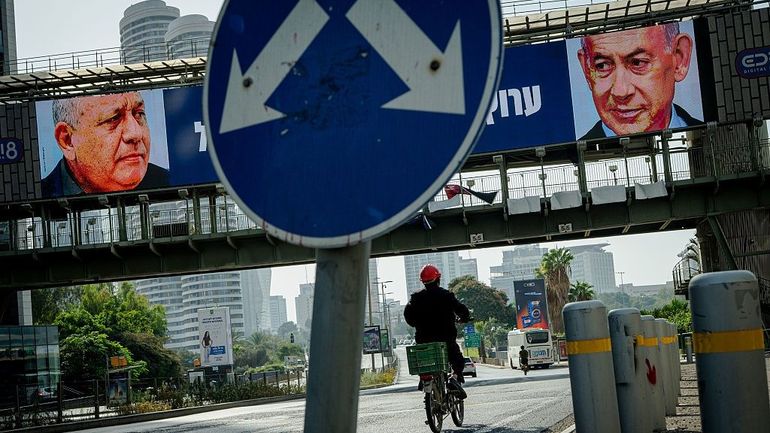
The Israelis began voting on Tuesday, October 27, 2026 for their first general election since Hamas attacked October 7, 2023. France 24, Blick, RTBF and Europe 1 describe an election dominated by Benjamin Netanyahu's record and the political divide in the country. Some 7.3 million voters are called to the polls, without a clear outcome in the polls reported. [S1] [S2] [S3] [S4]
A vote for parties, then negotiations
The offices opened at 05:00 GMT and must close at 20:00 GMT, according to the findings of AFP journalists taken by Blick and Europe 1. Television stations must then broadcast their first projections. These will not constitute the official results expected in the following days. The high level of participation announced by the Israeli media remains, at this stage, a forecast, not a recorded rate. [S2] [S4]
The right-wing and far-right coalition of the Prime Minister and the main opposition bloc, led by the former Chief of Staff, Gadi Eisenkot, are presented as colliding. No one seems to be confident of obtaining the 61 seats required by a majority. Associated Press points out that voters choose parties, which then negotiate alliances within a 120-member Knesset. The election does not therefore directly designate the head of government and could lead to several weeks or even months of negotiations. [S2] [S4] [S6]
Security and accountability at the heart of choice
Benjamin Netanyahu defends his continued power by highlighting the blows to Hamas in Gaza and Hezbollah in Lebanon. He is best placed to protect Israel despite the failures of October 7. The testimonies gathered by the RTBF and Associated Press illustrate this expectation among some of its constituents: they give it their confidence to ensure their safety. These opinions do not constitute an independent assessment of its assessment. [S3] [S6]
Gadi Eisenkot's camp promises a commission of inquiry to establish responsibility for the failures that led to the attack. It includes former Prime Ministers Naftali Bennett and Yair Lapid. For those citizens who demand accountability, this promise is about a concrete mechanism of accountability, but it is not yet implemented. Netanyahu's opponents also portray the election as decisive for democratic institutions, in a context of tensions with the judiciary and the Prime Minister's corruption trials. [S3] [S4]
However, the alternative is not just an opposition between the continuation and abandonment of military operations. Associated Press reports that Eisenkot renewed its commitment to dismantle or destroy Hamas' power within 18 months of the formation of a possible government. The agency also points out that the conduct of the war in Gaza was little debated during the campaign, despite the international criticisms highlighted by the French-speaking media. These perspectives are complementary: the external impact of the conflict alone does not indicate its place in the internal electoral debate. [S2] [S4] [S6]
Freedom to vote and control procedures
The involvement of Israeli Arab citizens is one of the challenges being addressed. Blick and Europe 1 report a deep sense of discrimination; Associated Press quotes the leader of Ra It is a political strategy and a expressed expectation, not of an acquired result or a preference that could be attributed to each Arab voter. [S2] [S4] [S6]
Another practical issue is the control of the vote. The Jerusalem Post reports that Yisrael Beytenu seized the Central Electoral Commission after an elector reportedly received an envelope in Beersheba containing a Likud ballot. This version comes from the complaining party; the publication consulted does not present a decision establishing the irregularity. It nevertheless documents the existence of a remedy, without making it possible to conclude that there was widespread fraud. [S5]
An open exit
The publications consulted converge on the opening of the election, the weight of October 7 and parliamentary uncertainty. Several French-language media, however, include AFP's common formulations and findings: their consistency does not represent as many independent surveys. There are no official results in these proceedings. The distribution of seats, then the ability of parties to form a majority, will determine whether the vote prolongs Netanyahu's power or opens an alternation. [S1] [S2] [S3] [S4] [S6]
Sources
- France 24Live: Opening of polling stations in Israel, Netanyahu at the test of ballot boxes
- Blick francophoneOpening of polling stations in Israel for legislative elections
- RTBF InfoIsrael: First legislative elections since 7 October, Netanyahu in the ballot box
- Europe 1Israel: Opening of polling stations for the first legislative elections since 7 October
- The Jerusalem PostIsrael Election 2026 live updates: Netanyahu, Eisenkot battle for power
- Associated Press / WSLSThe Latest: Israel vote in a tense election see as a referendum on Netanyahu