· Summary Prism
Presidential 2027: the Odoxa poll draws a duel Le Pen-Mélenchon, without guaranteeing the poster
The Odoxa-Backbone survey published on October 14 places Marine Le Pen largely in the lead and Jean-Luc Mélenchon ahead of Édouard Philippe in the first round. But the second place remains tight in this hypothesis, and the voting intentions of the second round remain marked by indecision. Several media reports on the same survey, not independent surveys.
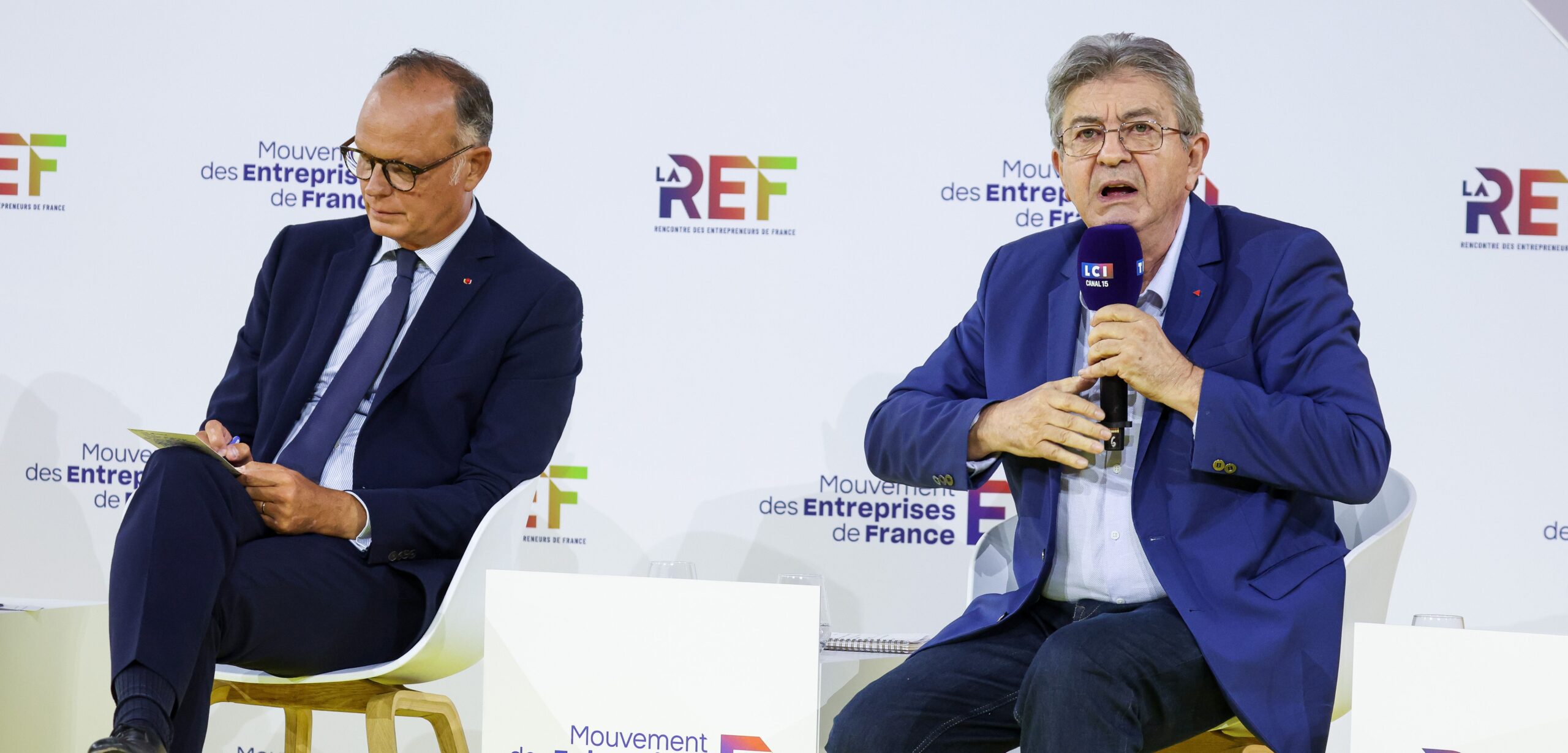
Marine Le Pen in the lead, Jean-Luc Mélenchon second and Édouard Philippe just behind: this is the configuration that emerges from the Odoxa-Backbone poll for Public Senate, Le Nouvel Obs and the regional press, published on October 14. South West, Public Sénat and Le Progrès describe the same hypothesis of a second round between the candidate of the National Rally and the candidate of La France insoumée. This media convergence concerns only one investigation: it does not constitute an accumulation of independent measures. [S1] [S3] [S6] [S8]
Second place played behind Marine Le Pen
In the scenario where Édouard Philippe represents the central bloc, Marine Le Pen collects 37% of voting intentions, Jean-Luc Mélenchon 18% and the Mayor of Le Havre 17%. In the case where Gabriel Attal replaces Édouard Philippe, the RN candidate reached 38%, ahead of Jean-Luc Mélenchon at 18.5% and Gabriel Attal at 11%. The unsuccessful candidate arrives second in the two configurations tested, but his lead over Édouard Philippe remains narrow. [S1] [S6]
Public Sénat states that the survey was conducted via the Internet from 24 September to 7 October 2026 among 12,005 French people representing the population aged 18 and over. The media indicates a margin of error in voting intentions between 0.6 and 1.2 points depending on the score observed. These factors suggest that the limited gap between Mélenchon and Philippe should not be transformed into an acquired qualification. [S6]
The choice of the central candidate also changes the situation on the right. Bruno Retailleau is credited 6.5% with Édouard Philippe, compared to 9% with Gabriel Attal. Raphaël Glucksmann reached 10.5% in the latter configuration. These results describe different electoral offers: they alone do not predict the effects of a withdrawal or alliance. [S6]
In the second round, very different power ratios
Assuming a duel Le Pen-Mélenchon, South West, reported 68% voting intentions for the RN candidate compared to 32% for the LFI candidate. A confrontation with Édouard Philippe would be tighter: the mayor of Le Havre would get 47%, while remaining ahead. The survey thus distinguishes two questions: the ability to access the second round and the ability to gather beyond its first electorate. [S1]
These figures remain subject to a substantial reserve. Odoxa points out, according to South West, that a large proportion of voters considering taking part in the second round are still undecided. The New Republic states that a third party hesitates about their candidate or envisages a blank or null vote. This group cannot therefore be presented as an automatically available tank for one of the suitors. [S1] [S8]
Candidates give competing readings
Progress reports the satisfaction of Manuel Bompard, campaign manager of Jean-Luc Mélenchon, who sees this survey as a sign of a favourable mobilization, particularly among young people. Conversely, Bruno Retailleau relativizes the scope of the polls several months before the election and relies on the credibility of his offer. These statements express campaign strategies, not demonstrations of the electoral outcome. [S3]
Public Senate also reports on the analysis of Gaël Sliman, d'Odoxa, according to which Bruno Retailleau's difficulties could promote a rapprochement with Édouard Philippe. This is a political interpretation attributed to the prober, not the announcement of an agreement. Nothing in the results presented guarantees that voters would follow any instructions from their politicians. [S6]
A photograph, not an imposed choice
The latest news from Alsace brings territorial light: Marine Le Pen would reach 43% in the Great East. This regional result should not be confused with its national score. It supplements the table without changing the nature of the survey, which measures intentions in given configurations. [S5]
Finally, the field of the poll precedes Raphaël Glucksmann's victory at the Social Democratic Primary, reported by South West: he therefore does not measure the possible effects of this result. For voters, the essential distinction remains that between a photograph of preferences and a verdict. Neither the repetition of the same survey in several media nor the "useful voting" strategies make the announced duel inevitable. [S1] [S3] [S6]
Sources
- Sud OuestPresidential 2027 : a poll announces a duel between Marine Le Pen and Jean-Luc Mélenchon in the second round
- Le ProgrèsPresident 2027. To a duel Marine Le Pen and Jean-Luc Mélenchon in the second round? What our survey reveals
- Dernières Nouvelles d’AlsacePresident 2027. Marine Le Pen very largely leads in the first round in the East, according to a poll
- Public SénatPresidential poll 2027 : Jean-Luc Mélenchon passes in front of Édouard Philippe in the first round, the center seeks its cape
- La Nouvelle RépubliquePresidential 2027 : Mélenchon passes Philippe in the first round, Le Pen remains largely favorite, according to the latest poll Odoxa