· Summary Prism
Presidential 2027 : in the Bourget, Mélenchon refuses to reduce his line to expand his electorate
In Le Bourget, Saturday, November 7, Jean-Luc Mélenchon rejected the calls to be "less cleavage". In front of some 20,000 people, according to the organizers, the candidate LFI defended the continuity of his plan to break up. A demonstration of mobilization that leaves open the question of his ability to convince beyond his supporters. [S1] [S2] [S6]
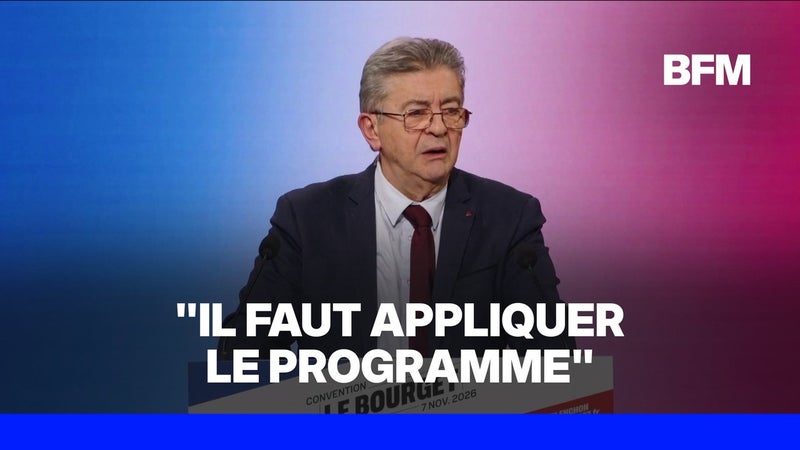
Jean-Luc Mélenchon did not want to change the line for the presidential election of 2027. At the Bourget Exhibition Centre on Saturday, November 7, the candidate of La France insoumée rejected the recommendations inviting him to moderate his speech: "I will not do it", he responded to the calls to put "water in [his] wine". BFMTV, Sud Ouest, franceinfo and CNews report on the same statement, delivered at the meeting devoted to its presidential programme. [S1] [S2] [S3] [S4]
Program fidelity as an electoral argument
The candidate's reasoning is explicit: reducing his position to attract more voters would, in his view, be opportunistic and ineffective. CNews and RTS report that he sees it as a "political attitude" likely to disappoint without convincing. On the contrary, he promises to continue the campaign until the end and claims to be able to win. It is a political commitment and conviction, not an acquired result. [S4] [S5]
This firmness does not exclude for his team an expansion of the topics discussed. LFI's coordinator, Manuel Bompard, explained that he wanted to keep the break-up project, while giving more space to previously less mentioned topics, including "ecological diseases". The aim is therefore to broaden the content of the campaign rather than moderate its orientation. [S2] [S3]
Proposals that directly affect daily life
The gathering followed the release in bookstore on Friday of a new edition of the "Avenir en commun", including 1,069 proposals. Before the speech, several figures in the movement presented elements of the program in staged sequences. South West and France 24 describe a collective presentation, designed to make the policies defended visible as much as the team called upon to wear them. [S2] [S3] [S6]
Among the measures presented, the RTS mentions a minimum wage raised to 1,700 euros net, the return of retirement to 62 years and then to 60 years of age, as well as the abolition of Parcoursup. These commitments relate directly to income, end of career and access to higher education. The report of the meeting, however, does not detail their financing, their full schedule, or the rules for the courseup that would replace the device: it does not allow for a precise assessment of the consequences for each person. [S5]
Clarity of commitments is itself an argument for support. In France 24's report, one participant felt that the programme allowed for a concrete discussion of the proposed change. For voters, the distinction remains essential between knowing a candidate's intentions and having the evidence to judge their feasibility, costs and effects on individual choices. [S6]
A major mobilisation, not a majority guarantee
The reports point to the influx of around 20,000 people, or even beyond, by assigning this estimate to the organizers. This figure measures a mobilisation claimed by LFI, not an independent count. The enthusiasm of the room and calls for victory are reported by several media, but they do not themselves inform about the membership of all voters. [S2] [S3] [S4] [S6]
The main obstacle mentioned in these articles is that of the second round. BFMTV, Sud Ouest and France 24 report polls placing Mélenchon in a qualifying position, but losing against Marine Le Pen. The methodological notes of these surveys are not included in the records consulted: this reported trend must be distinguished from a certain forecast of the vote. Mélenchon, for his part, disputes precisely the idea of an inevitable defeat. [S1] [S2] [S6]
An assumed line, a gathering capacity still discussed
The media shed different light on this tension. BFMTV emphasizes the refusal of moderation; South West insists on militant demonstration; France 24 confronts the assurance of sympathizers with the resistance of the candidate. The latter also notes the contrast between a speech of rupture and a campaign poster to the rural landscape, which it brings closer to mitterrandian imagery. This reading is a journalistic analysis, not an established program change. [S1] [S2] [S6]
In Bourget, Mélenchon chose to defend constancy rather than inflection. The question left open is electoral: can this fidelity claimed convince enough people beyond the support already mobilized? Neither the crowd of the meeting nor the promise of victory make it possible to decide it. [S4] [S5] [S6]
Sources
- BFMTVPresident 2027: "Put water in my wine? I won't do it," says Jean-Luc Mélenchon (LFI)
- Sud OuestPresidential 2027: sure of his strength, Mélenchon refuses to be "less cleavage" at his giant meeting in Bourget
- franceinfoSince his meeting at the Bourget, Jean-Luc Mélenchon refuses to put "water in" his "wine to seduce and be less cleavant"
- CNewsPresident 2027: Jean-Luc Mélenchon refuses to be "less cleavage" and assures that he will not "get water in his wine"
- RTS with AFP" We're going to win" : Jean-Luc Mélenchon made another demonstration of strength at his meeting at the Bourget
- France 24With a new demonstration of strength by Jean-Luc Mélenchon, the insoumis already see